About Dijla Health
The digital river running through Iraqi healthcare.
A national health infrastructure in Iraq — built with the same care, flow, and continuity as the Tigris that gives Dijla Health its name.
Not a foreign product translated into Arabic. Designed from the ground up for Iraqi clinical workflows, regulation, and the Iraqi patient’s trust.
Why “Dijla”
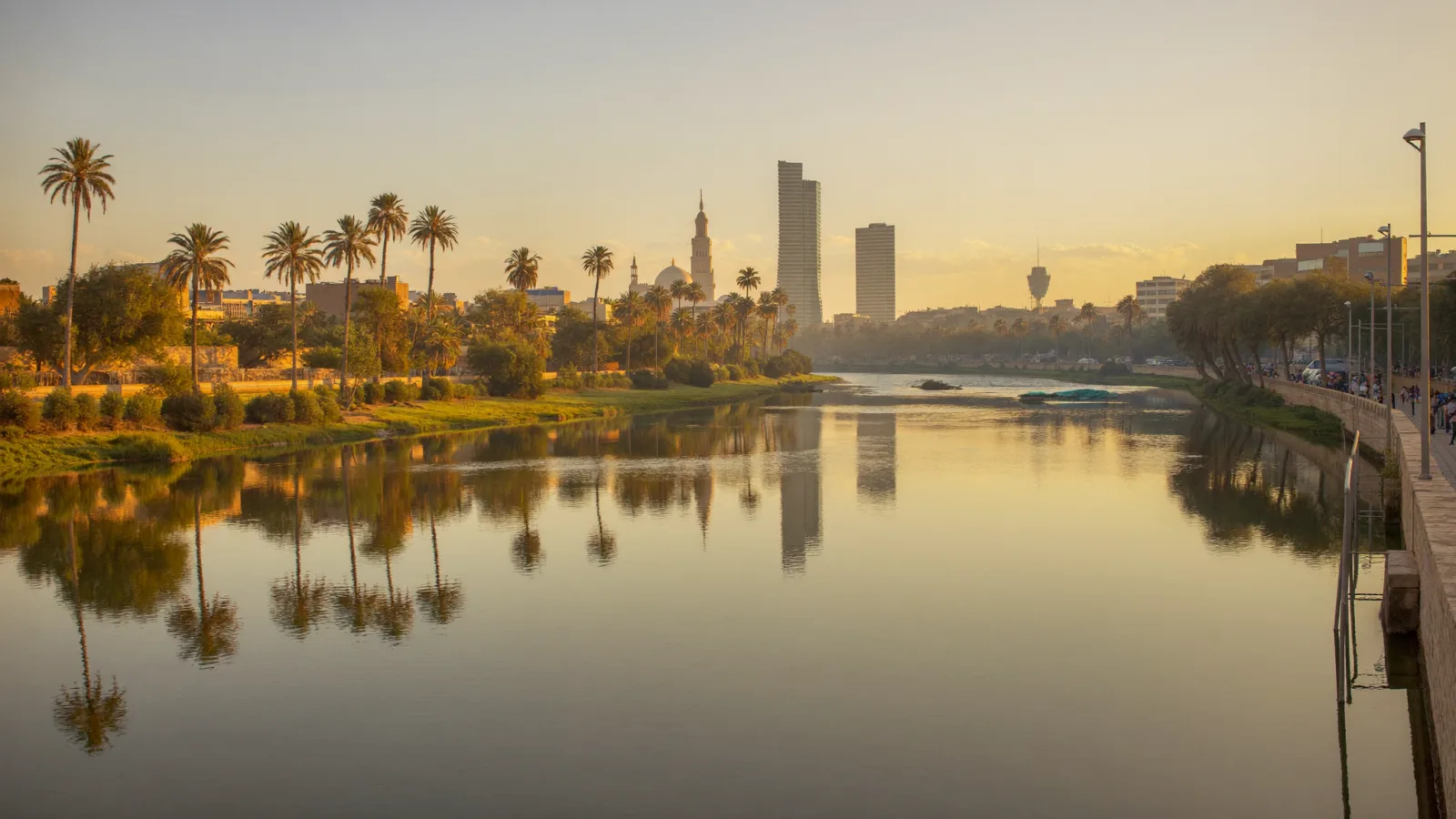
Named for the river that has sustained Iraq for ten thousand years.
Dijla is the Arabic name for the Tigris — one of the two great rivers that have sustained civilization in Mesopotamia for more than ten thousand years. It flows from the mountains of the north, through the heart of Baghdad, to the Gulf — connecting north to south, mountain to sea, city to countryside.
Dijla Health carries that name deliberately. Healthcare in Iraq should flow the same way: connected, continuous, life-sustaining. A patient’s record should travel with them — not stay locked in one clinic’s filing cabinet. Information should reach the right clinician at the right moment, with the patient’s consent, the way the Tigris reaches every field it passes.
The platform was built to be that backbone — not temporary infrastructure, but the permanent digital river running through Iraqi healthcare.
Our mission
Build the national health backbone in Iraq — one platform every clinic, pharmacy, lab, and radiology center can trust, where every role sees only what it is allowed to see and every patient owns their own record.
Our vision
A future where an Iraqi patient’s health record travels safely with them — from Basra to Erbil, from clinic to pharmacy to lab — and their doctor always has the full picture, with the patient’s consent.
What we’ve built
Tangible delivery, not just vision.
- v0.2Patient & Family Health CoreMay 2026
Adult profiles, family members, pregnancy and newborn skeleton, the consent engine, and the health timeline.
- v0.3Provider VerificationMay 2026
Clinic, doctor, pharmacy, lab, and radiology verification; employee credentialing; automated workflows.
- v0.4Clinic WorkflowJune 2026
Appointments, check-in, encounters, the clinical prescription surface, and referrals.
- v0.5Prescription & PharmacyJune 2026
The full prescription lifecycle, pharmacy inventory, medicine catalog, anti-counterfeit signals, and dispensing.
- v0.6Lab & RadiologyJune 2026
Lab orders and results, radiology orders and reports, FHIR R4, and three-layer separation of duty.
Running totals as of v0.6: 3,782 passing tests · 34 backend modules · 229 audit event types · FHIR R4 · 5 milestones shipped.
What we stand for
Six principles that are load-bearing, not decorative.
Arabic first, not Arabic afterthought
Every screen is designed in Arabic, with full RTL layout. English is fully supported — both are first-class. Arabic is never a translation bolted on at the end.
Privacy by design
HIPAA-inspired and GDPR-inspired protections are implemented voluntarily — because it is the right standard, and because Iraqi patients deserve it even as national data-protection law matures.
Human-in-the-loop AI
AI assists — summarize, score, flag, translate; humans approve. AI never diagnoses, prescribes, approves results, or overrides consent. Every AI action is logged, and no AI operates outside the requesting user’s permission scope.
Government-ready at all times
The inspection evidence folder is maintained continuously, not assembled in a panic. Every release updates it.
Built for all Iraqis
Refugees, IDPs, undocumented patients, and newborns without a registered national ID are first-class patients. No one is excluded because of document status.
No pharmacy edits a doctor’s prescription
Ever. A pharmacist can fulfill, reject, request clarification, or suggest an allowed alternative. The clinical record is tamper-proof.
What’s next
The river keeps flowing.
Clinic Operation System — a complete role-scoped operation system for the clinic.
Extending the model to pharmacies, labs, and radiology centers.
Finance — billing, receipts, and financial reporting.
Pediatric & OB depth, then dental and aesthetic specializations, toward the pilot launch.
About the platform
Questions people ask about Dijla Health.
Why is the platform called Dijla?
Dijla is the Arabic name for the Tigris. We chose it because healthcare should flow the way the Tigris does — continuously, connecting every part of Iraq, sustaining life.
When was the platform built?
Development began in 2026. Five major milestones have shipped as of mid-2026, with the platform already running in staging.
What standards does the platform follow?
FHIR R4 for interoperability, OWASP ASVS for application security, NIST CSF 2.0 for cybersecurity governance, ISO 27001 concepts for information security, and WHO child-growth standards for pediatric modules.
Is there a roadmap?
Yes. v0.7 (Clinic Operation System) is active. v0.8 extends the model to pharmacies, labs, and radiology. v0.9 adds finance. v1.x adds pediatric/OB and dental/aesthetic specializations.
Will the platform integrate with the Iraqi Ministry of Health?
The architecture is designed for it. Government integrations — facility licensing, medical syndicate, drug registry, and the national EHR — are on the roadmap; manual verification workflows bridge the gap while those APIs mature.
Does the platform support the Kurdistan Region?
Yes. MoH-licensed facilities in Erbil and Sulaymaniyah can onboard. Kurdish (Sorani/Kurmanji) localization is planned after the MVP.
Join us as an early clinic partner.
We’re onboarding a first cohort of clinics, pharmacies, and labs across Iraq. Help shape the platform that Iraqi healthcare deserves.
Become an early partner